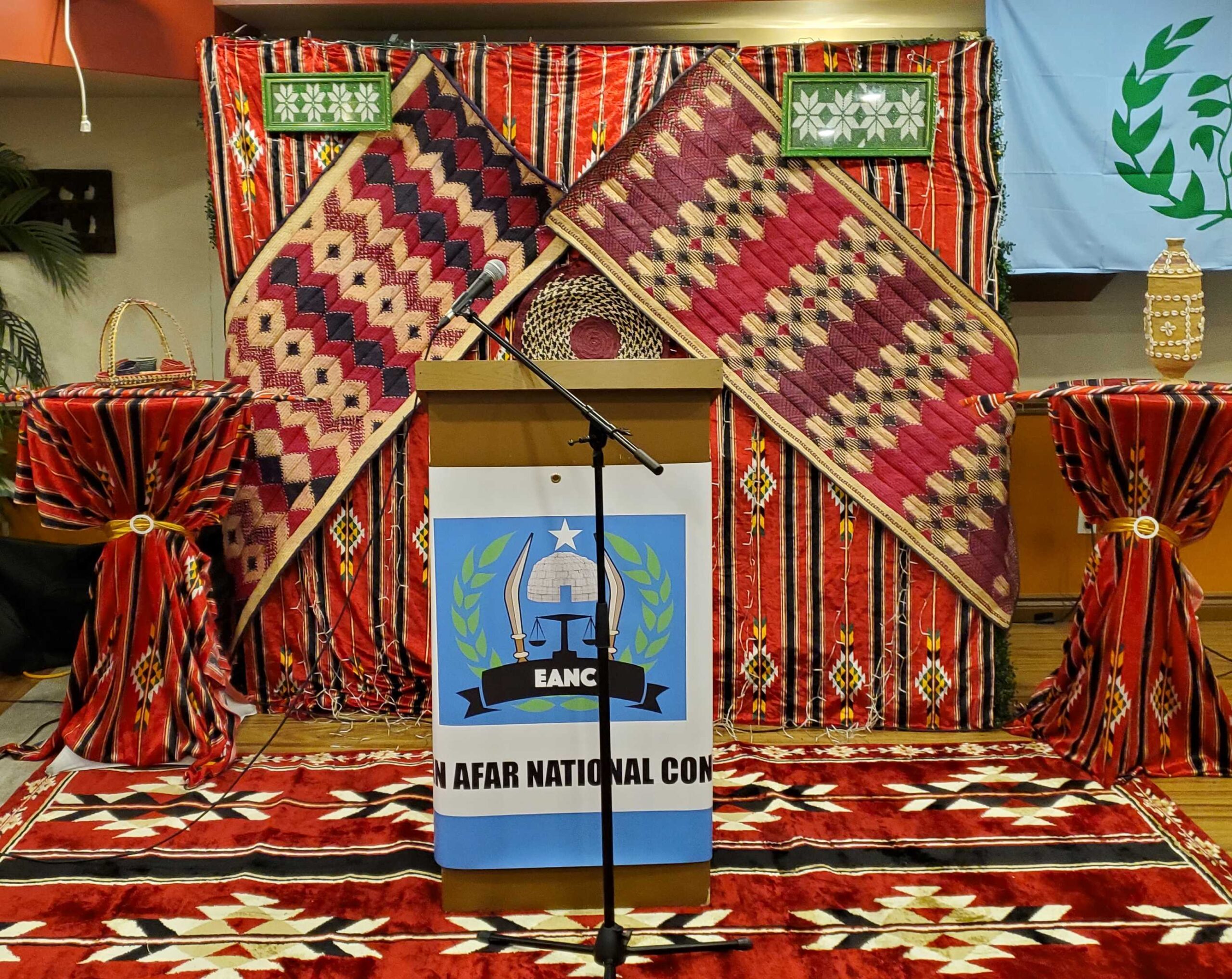
Resolution of the 3rd Congress of the Eritrean Afar National Congress (EANC) Date: July 3–4, 2026

Resolution of the 3rd Congress of the Eritrean Afar National Congress (EANC)
Date: July 3–4, 2026
Theme: “Unity Through Federalism, Equality Through Self-Government, and Democracy Through Shared Governance”
Resolution of the Third Congress
The Eritrean Afar National Congress (EANC), representing the political aspirations of the Indigenous Afar people in Eritrea, convened its Third National Congress on 3–4 July 2026 with the participation of Afar traditional authorities, political leaders, women, youth, refugees, scholars, civil society representatives, democratic partners, and international friends of the Afar Nation.
Following two days of extensive deliberations, the Congress reaffirmed the unwavering commitment of the Eritrean Afar Nation to continue its struggle for internal self-determination, restoration of Indigenous rights, democratic self-government, and regional autonomy in Dankalia within a united, democratic, decentralized federal Eritrea.
The Congress elected 26 members to the Central Committee and 11 members to the Executive Committee.
The Congress overwhelmingly re-elected Ahmed Youssouf Mohamed as President and Abdalla Hamid Hussein as Vice President of the Eritrean Afar National Congress to serve a four-year mandate ending at the Fourth Congress in 2030.
The Congress congratulates the newly elected leadership and entrusts them with advancing the struggle of the Afar Nation through principled leadership, unity, diplomacy, and democratic resistance.
- Mandate and Solidarity of the Afar Nation
The Third Congress received overwhelming support and legitimacy from the historic Afar Sultanates and traditional authorities who participated throughout the Congress.
The traditional leadership reaffirmed its confidence in the EANC leadership and mandated it to continue defending the rights of the Indigenous Afar Nation until the restoration of Afar self-government and the liberation of Dankalia from the system of internal colonization imposed by the current Eritrean regime under People’s Front for Democracy and Justice (PFDJ).
Sheikh Ahmed Mohamed Ahaw, representing the Sultanates of Bidu (Girrifo), addressed the Congress and called upon the leadership to strengthen Afar unity, continue documenting atrocities committed against the Afar people, preserve the historical record of the Afar Nation, and ensure future generations understand the sacrifices made by their ancestors in defending their homeland and identity.
Sheikh Ahmed Ahaw emphasized that preserving Afar history is itself an act of resistance against attempts to erase the Indigenous identity of Dankalia.
The Congress also welcomed Sheikh Ahmed Youssuf Abubakar, a veteran of the Eritrean liberation front (ELF) and envoy for the Sultanate of Rahaita, who attended the conference from Obock, Djibouti. Speaking on behalf of the Afar constituency, Sheikh Ahmed encouraged the EANC to intensify collaboration with democratic Eritrean movements and international stakeholders to restore traditional Afar governance, reclaim ancestral lands, and establish democratic self-determination within Dankalia.
The Chairman of the Afar Forum, Mr. Nouman Moussa Danaba, delivered a message of solidarity reaffirming his organization’s commitment to working closely with the Eritrean Afar National Congress (EANC). He emphasized the importance of strengthening cooperation and called for greater unity among Eritrean Afar opposition organizations to advance a common struggle in addressing the political, social, and human rights challenges facing the Afar people in Eritrea.
The Afar traditional leadership collectively called upon regional governments and the international community to support the establishment of a permanent Pan-Afar Traditional Authority and Legal Council that would preserve Afar customary law (Mad’a), strengthen traditional governance, and safeguard the collective rights of the Afar people across Eritrea, Ethiopia, and Djibouti.
The Congress expresses profound gratitude to the historic Afar Sultanates, traditional elders, religious leaders, and grassroots communities for their unwavering support and reaffirms the EANC’s commitment to work hand in hand with the Afar people throughout the Afar homeland.
- Unity of Eritrean Afar Opposition Organizations
The Congress recognized that strengthening Afar unity has been one of the EANC’s highest strategic priorities during the past four years.
Significant efforts have been undertaken to build trust among Eritrean Afar political organizations and overcome decades of fragmentation.
The Congress warmly welcomed congratulatory messages from Comrade Ibrahim Harun, Chairman of the Red Sea Afar Democratic Organization (RSADO), who expressed his organization’s readiness to deepen cooperation with the EANC.
The Congress also welcomed the participation of Comrade Ahmed Redo, Vice President of the Dankalia People’s Movement (DPM-95), who acknowledged the EANC’s leading international advocacy before United Nations human rights mechanisms and called for greater unity among Afar political movements.
The Congress recognized the significant progress made toward strengthening Afar political unity through the bilateral Memoranda of Understanding (MoUs) previously concluded by the Eritrean Afar National Congress (EANC) with both the Red Sea Afar Democratic Organization (RSADO) and the Dankalia People’s Movement (DPM-95).
The Congress welcomed these agreements as historic confidence-building measures and an important foundation for the eventual establishment of a single, united Afar political umbrella representing the collective aspirations of the Eritrean Afar people.
The Congress further commended the leadership of EANC, RSADO, and DPM-95 for demonstrating political maturity, strategic vision, mutual trust, and a shared commitment to overcoming organizational fragmentation. It reaffirmed that greater Afar unity is essential to strengthening the national movement, accelerating democratic change in Eritrea, and advancing the struggle for Afar internal self-determination, self-government, Indigenous rights, and constitutionally guaranteed autonomy in Dankalia.
III. International Experts and United Nations Solidarity
The Third Congress was honored by the participation of distinguished international experts, United Nations officials, constitutional scholars, and democratic leaders whose longstanding support has significantly strengthened the struggle of the Indigenous Afar Nation.
Professor Mohamed Abdelsalam Babiker
United Nations Special Rapporteur on the Situation of Human Rights in Eritrea
The Congress welcomed Professor Mohamed Abdelsalam Babiker, who reaffirmed that the plight of the Indigenous Afar remains among the gravest human rights concerns in Eritrea. Throughout his six-year mandate, he consistently documented discrimination, arbitrary arrests, enforced disappearances, forced displacement, violence, and the systematic persecution of the Afar people.
The Congress expresses its profound appreciation to Professor Babiker for his courage, professionalism, and unwavering commitment to truth, accountability, and the protection of human rights in Eritrea.
Professor Joseph Magnet
Honorary Citizen of the Afar Nation and Constitutional Adviser to the EANC
The Congress likewise expresses its deep gratitude to Professor Joseph Magnet for his decades of dedicated service to the Afar Nation.
Congratulating the newly elected leadership, Professor Magnet praised the resilience of the Afar people and emphasized that Eritrea’s democratic transition is drawing nearer. He encouraged the Afar Nation to prepare politically, institutionally, and constitutionally to govern their homeland through democratic self-government within a federal constitutional framework.
Professor Magnet reaffirmed his continued commitment to advancing the Afar cause before the international community and supporting constitutional solutions founded on democracy, Indigenous rights, and the rule of law.
His Excellency Getachew Reda
Ministerial Advisor on East African Affairs to the Prime Minister of the Federal Democratic Republic of Ethiopia
His Excellency Getachew Reda reaffirmed his strong support for the Afar people’s legitimate aspirations for self-government and constitutional recognition.
Addressing the Congress, he declared: “If there are any people better entitled to self-government, it must be the Afar people—whether they are in Djibouti, Ethiopia, or Eritrea.”
He further reassured the Congress of his personal commitment to the Afar cause, describing himself as “one of the Afar,” and pledged to continue supporting the struggle for justice, dignity, and the restoration of the rights of the Afar Nation.
Dr. Nagash Osman Ibrahim
Chairman, Eritrean National Congress for Democratic Change (ENCDC)
Dr. Nagash Osman Ibrahim reaffirmed the ENCDC’s full solidarity with the legitimate struggle of the Afar people and its strong partnership with the Eritrean Afar National Congress.
He emphasized that protecting Afar ancestral lands, identity, historical rights, and the right to self-government forms an integral part of the ENCDC’s vision for a democratic Eritrea founded upon equal citizenship, constitutional governance, justice, and the rule of law.
He concluded by stating:
“Restoring justice to the people of Dankalia is not only an Afar cause—it is a national democratic imperative essential to achieving lasting peace, national unity, and democratic transformation in Eritrea.”
The Congress welcomed these expressions of solidarity as further evidence of the growing national and international consensus that safeguarding the rights of the Indigenous Afar people is inseparable from the broader struggle for democracy, constitutional governance, and lasting peace in Eritrea.
- Resolution to the African Union
The Congress calls upon the African Union to recognize the Eritrean Afar as one of Africa’s most marginalized Indigenous peoples.
The Congress urges the African Commission on Human and Peoples’ Rights (ACHPR) to investigate Eritrea’s violations of the African Charter, including violations of:
- the right to equality;
- freedom from discrimination;
- participation in public affairs;
- cultural rights;
- property rights;
- peoples’ rights over natural resources;
- and the collective rights of Indigenous communities.
The Congress further calls upon the African Union to strengthen accountability mechanisms regarding Eritrea’s treatment of the Afar people.
- Resolution to IGAD
Recognizing that the Afar Nation is an Indigenous transboundary people whose historic homeland extends across Eritrea, Ethiopia, and Djibouti, the Congress calls upon the Intergovernmental Authority on Development (IGAD) to place the Afar question on the agenda of its upcoming ministerial and Heads of State meetings. Consistent with its mandate to promote regional peace, security, economic cooperation, and sustainable development, IGAD should address the continued political, economic, and cultural marginalization of the Afar people, particularly in Eritrea.
The Congress further recalls that IGAD has acknowledged the historical marginalization of transboundary pastoralist communities, including the Afar, and has recognized that failure to protect customary governance systems and communal land rights has contributed to conflict and instability in the region. Accordingly, the Congress urges IGAD to utilize its political, peacebuilding, and regional integration mechanisms to promote the protection of Afar Indigenous rights, customary institutions, communal land tenure, and meaningful participation in regional decision-making in accordance with the African Charter on Human and Peoples’ Rights and other applicable regional and international human rights standards.
- Resolution to the United Nations General Assembly
The Congress expresses profound disappointment over the election of Eritrea to the United Nations Economic and Social Council (ECOSOC), despite the country’s well-documented record of systematic human rights violations.
The Congress believes that rewarding a government accused by successive United Nations investigations of crimes against humanity undermines the credibility of the United Nations human rights system.
The Congress calls upon the United Nations to continue monitoring Eritrea and to ensure greater protection of the Indigenous Afar people’s rights to preserve their culture, language, traditional economy, and ancestral way of life.
VII. Resolution to the European Union, Canada, and the United States
The Congress calls upon the European Union, the Government of Canada, and the United States Government to continue scrutinizing Eritrea’s human rights record and to prioritize protection and humanitarian assistance for Eritrean Afar refugees.
Special attention should be directed toward Afar refugees living in:
- Obock refugee settlements in Djibouti;
- Al-Khokha refugee communities in Yemen;
- Aysaita refugee settlements in Ethiopia;
- Barahle refugee camps in Ethiopia.
The Congress notes with grave concern that an estimated 200,000 Eritrean Afar have been internally displaced or forced into exile over the past two decades as a result of persecution, forced displacement, and the destruction of their traditional livelihoods.
The Congress further calls upon the European Union, Canada, and the United States to work closely with the United Nations High Commissioner for Refugees (UNHCR) and other humanitarian partners to prioritize emergency assistance, protection, education, healthcare, and durable solutions for Eritrean Afar refugees and displaced communities, while ensuring that adequate resources are allocated to address their urgent humanitarian needs and long-term resilience.
VIII. Resolution to Indigenous Rights Organizations
The Congress calls upon Indigenous rights organizations worldwide, including the UN Special Rapporteur on the Rights of Indigenous Peoples, the International Work Group for Indigenous Affairs (IWGIA), Congress of Nations and States (CNS) and other international Indigenous institutions, to expand cooperation with the Eritrean Afar Nation.
The Congress calls for international support to advance the recognition of Indigenous self-government, protect ancestral lands and resource rights, strengthen customary governance institutions, uphold the principle of Free, Prior and Informed Consent (FPIC), and preserve the Afar people’s culture and language.
- Resolution to the Eritrean Democratic Opposition
Guided by the Congress theme, “Unity Through Federalism, Equality Through Self-Government, and Democracy Through Shared Governance,” the Congress calls upon all Eritrean democratic organizations, civil society, youth, women, and national communities to strengthen dialogue, cooperation, and unity in pursuit of a peaceful democratic transition. The Congress urges the development of a shared national vision founded on constitutional reform, human rights, the rule of law, and democratic governance.
The Congress reaffirms that federalism is not a threat to Eritrea’s sovereignty, but the constitutional foundation for preserving national unity through equality and shared governance. A decentralized federal system prevents domination by any one group, guarantees meaningful regional self-government, protects the rights of all national communities, and offers the most peaceful and democratic solution to Eritrea’s long-standing political crisis.
- Closing Declaration
The Third Congress declares that the future of Eritrea cannot be built upon dictatorship, exclusion, or domination. Instead, it must be founded on constitutional democracy, equality among all national communities, regional self-government, Indigenous rights, justice, and shared governance.
The Congress reaffirms that Dankalia is the historic homeland of the Indigenous Afar Nation and calls for its constitutional recognition as the Autonomous Afar State within a decentralized federal Eritrea, exercising democratic self-government while remaining an integral part of one sovereign Eritrean state.
The Congress further affirms the Afar people’s collective rights to govern, protect, and equitably benefit from their ancestral lands, coastal territories, natural resources, and the Port of Assab. It calls for constitutional guarantees protecting Afar identity, language, customary institutions, and the rights of future generations to preserve and develop their Indigenous heritage.
The Congress pledges that the Eritrean Afar Nation will continue its determined struggle until justice, dignity, internal self-determination, self-government, equality, and constitutional democracy are secured for all the peoples of Eritrea.
The Congress expresses its sincere appreciation to all distinguished speakers, presenters, panelists, traditional leaders, and guests for their valuable contributions and solidarity. Special thanks are extended to our international partners, United Nations representatives, constitutional scholars, democratic leaders, and all those who conveyed messages of support.
The Congress also thanks the organizing committee, volunteers, technical team, translators, and participants whose dedication ensured the success of the Third Congress of the Eritrean Afar National Congress (EANC).
Adopted unanimously by the Third Congress of the Eritrean Afar National Congress (EANC)
July 4, 2026
Email: info@dankalia.org